Research Papers 研究论文

Human
Interdependence
Paradigm
Human
Interdependence
Paradigm

The traditional paradigm of education has become obsolete in the age of AI. The following articles explore different elements of the new paradigm of education. These are all open-access journal articles. Yong Zhao's most recent book Fix the Past or Invent the Future: Moving Beyond One-Size-Fits-All Education provides a summary of the need for a new paradigm and elements of the new paradigm. 传统教育范式在 AI 时代已经过时。以下文章探讨了新教育范式的不同要素,均为开放获取的期刊论文。赵勇最新著作《Fix the Past or Invent the Future: Moving Beyond One-Size-Fits-All Education》总结了理论路径的必要性及其要素。
July 2024 – March 2026 2024年7月 – 2026年3月
AI and Education cover
July 2024 2024年7月

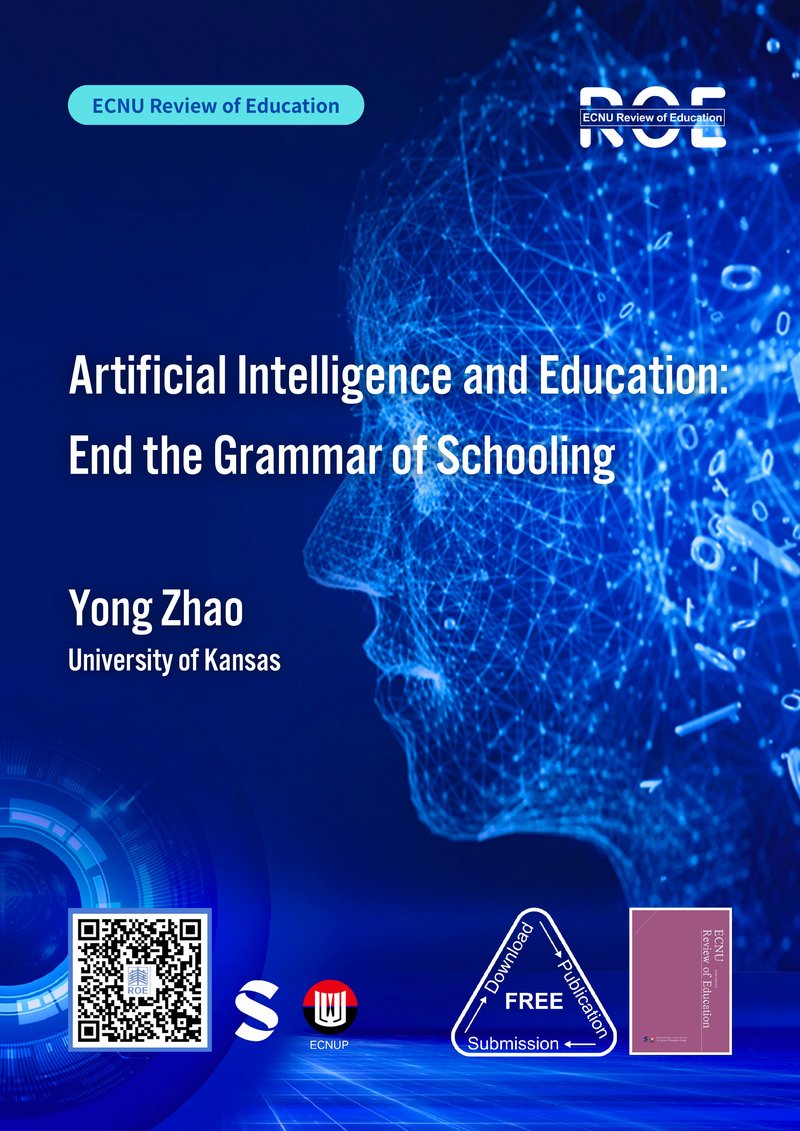
Artificial Intelligence and Education: End the Grammar of Schooling 人工智能与教育:终结学校教育的语法

Yong Zhao

Artificial Intelligence and Education: End the Grammar of Schooling 人工智能与教育:终结学校教育的语法

This article explores how artificial intelligence can fundamentally transform the structures and practices of education that have persisted for over a century — what has been called the "grammar of schooling." It examines why these deeply entrenched patterns of age-graded classrooms, standardized curricula, and uniform assessments have resisted change despite decades of reform efforts. The article argues that AI presents a unique opportunity to finally disrupt these patterns by enabling truly personalized learning experiences, reimagining the role of teachers, and creating new possibilities for how, when, and where learning occurs. 本文探讨人工智能如何从根本上改变持续了一个多世纪的教育结构和实践——即所谓的"学校教育的语法"。文章审视了按年龄分级的课堂、标准化课程和统一评估等根深蒂固的模式为何在数十年的改革努力下仍然顽固不化。文章认为,人工智能提供了一个独特的机会,通过实现真正个性化的学习体验、重新构想教师角色以及创造学习方式、时间和地点的新可能性,最终打破这些模式。

Read Paper 阅读论文
Paradigm Shifts cover
October 2024 2024年10月

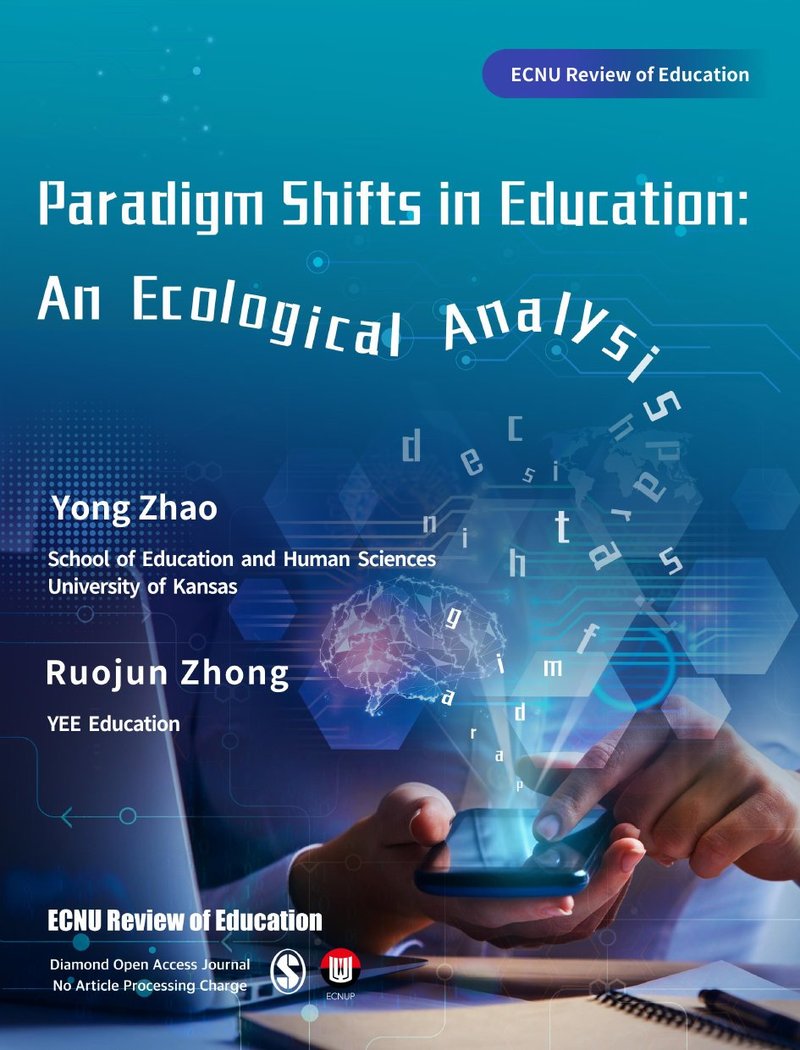
Paradigm Shifts in Education: An Ecological Analysis 教育范式转换:生态学分析

Yong Zhao and Ruojun Zhong

Paradigm Shifts in Education: An Ecological Analysis 教育范式转换:生态学分析

This article offers an ecological analysis of paradigm shifts in education, examining how transformations in technology, assessment, policy, and social context interact as parts of a larger educational ecosystem. Rather than treating reform as a set of isolated interventions, it argues that meaningful paradigm change depends on the relationships among actors, institutions, values, and environments. The analysis frames educational change as systemic, dynamic, and deeply interconnected, especially in the age of artificial intelligence. 本文从生态学视角分析教育范式转变,考察技术、评估、政策和社会情境的变化如何作为更大教育生态系统的一部分相互作用。文章并不将教育改革视为一系列彼此孤立的干预措施,而是认为真正的范式转变取决于行动者、制度、价值观与环境之间的关系。该分析将教育变革界定为一种系统性的、动态的且深度互联的过程,尤其是在人工智能时代。

Read Paper 阅读论文
Education Paradigm Shifts in the Age of AI cover
February 2025 2025年2月

Education Paradigm Shifts in the Age of AI: A Spatiotemporal Analysis of Learning AI时代的教育范式转换:学习的时空分析

Ruojun Zhong and Yong Zhao

Education Paradigm Shifts in the Age of AI: A Spatiotemporal Analysis of Learning AI时代的教育范式转换:学习的时空分析

This article offers a spatiotemporal analysis of education paradigm shifts in the age of artificial intelligence. It examines how AI is reshaping when, where, and how learning occurs, moving beyond fixed school structures toward more flexible, personalized, and networked forms of learning. By analyzing the temporal and spatial dimensions of educational change, the paper argues that the age of AI requires a fundamental rethinking of learning environments, institutional arrangements, and the relationships among learners, teachers, and knowledge. 本文对人工智能时代教育范式转变进行了时空分析。文章考察人工智能如何重塑学习发生的时间、空间和方式,推动教育从固定的学校结构走向更灵活、个性化和网络化的学习形态。通过分析教育变革的时间维度与空间维度,论文指出,AI时代要求我们从根本上重新思考学习环境、制度安排以及学习者、教师与知识之间的关系。

Read Paper 阅读论文
From Meritocracy to Human Interdependence cover
June 2025 2025年6月

From Meritocracy to Human Interdependence: Redefining the Purpose of Education 从精英主义到人类相互依存:重新定义教育的目的

Yong Zhao and Ruojun Zhong

From Meritocracy to Human Interdependence: Redefining the Purpose of Education 从精英主义到人类相互依存:重新定义教育的目的

This paper critiques meritocracy's foundational assumptions, arguing that its focus on ranking individuals according to flawed metrics fosters unhealthy competition, overlooks diverse human talents, fails to account for unequal starting points, and ultimately hinders both individual fulfillment and societal progress. We propose an alternative framework, the Human Interdependence Paradigm, which redefines the purpose of education. HIP emphasizes cultivating unique individual greatness. It posits that the value of this greatness is realized through applying it to solve meaningful real-world problems for others, fostering a sense of purpose and mutual reliance. 本文批判了精英主义的基本假设,认为其按有缺陷的指标对个体进行排名的做法助长了不健康的竞争,忽视了多元的人类才能,未能考虑不平等的起点,最终阻碍了个人成就和社会进步。我们提出了一个替代框架——人类相互依存范式(HIP),重新定义教育的目的。HIP强调培养独特的个人卓越。它认为,这种卓越的价值通过将其应用于为他人解决有意义的现实世界问题来实现,从而培养使命感和相互依赖。

Read Paper 阅读论文
Death and Rebirth of Research cover
August 2025 2025年8月

The Death and Rebirth of Research in Education in the Age of AI: Problems and Promises 人工智能时代教育研究的消亡与重生:问题与前景

Yong Zhao, Neal Kingston, and Rick Ginsberg

The Death and Rebirth of Research in Education in the Age of AI: Problems and Promises 人工智能时代教育研究的消亡与重生:问题与前景

This article critically examines the enduring problems and emerging possibilities of educational research in light of rapid advances in artificial intelligence (AI). It seeks to understand why educational research has struggled to influence practice and policy meaningfully and explores how AI necessitates a fundamental rethinking of research purposes, methods, and epistemologies. The article identifies and analyzes seven major problems in traditional educational research, including flaws in peer review, quantification bias, methodological fragmentation, overgeneralization, neglect of individual learner diversity, limited educational imagination, and narrow outcome measures. It then explores how AI technologies challenge and reshape core assumptions about knowledge production and educational inquiry. 本文批判性地审视了在人工智能快速发展背景下教育研究中持续存在的问题和新兴的可能性。文章试图理解为什么教育研究一直难以对实践和政策产生有意义的影响,并探讨人工智能如何要求从根本上重新思考研究目的、方法和认识论。文章识别并分析了传统教育研究中的七大问题,包括同行评审缺陷、量化偏见、方法论碎片化、过度概括化、忽视个体学习者多样性、有限的教育想象力和狭隘的成果衡量标准。随后探讨了人工智能技术如何挑战和重塑关于知识生产和教育探究的核心假设。

Read Paper 阅读论文
Double-Helix Logic of Curriculum cover
February 2026 2026年2月

The Double-Helix Logic of Curriculum: Reframing Universality and Personalization in the Age of Artificial Intelligence 课程的双螺旋逻辑:在人工智能时代重构普适性与个性化

Ruojun Zhong and Yong Zhao

The Double-Helix Logic of Curriculum: Reframing Universality and Personalization in the Age of Artificial Intelligence 课程的双螺旋逻辑:在人工智能时代重构普适性与个性化

This article examines how education systems should redefine what and how students learn in the age of artificial intelligence (AI). It critiques the persistence of universalist frameworks that prescribe a single profile of the "ideal graduate" and argues for a double-helix logic of curriculum that balances universality with personalization. The article synthesizes insights from multiple disciplines and draws on cases from multiple countries, integrating multiple conceptual frameworks to evaluate the limitations of one-size-fits-all approaches and illustrate a more dynamic and integrated framework. Analysis reveals that prevailing reforms continue to reinforce uniformity. Instead, what we need is a curriculum logic that ensures that all students acquire societal and ethical foundations while enabling them to pursue personalizable strengths, passions, and real-world applications. 本文探讨了在人工智能时代教育体系应如何重新定义学生学什么以及如何学。文章批判了持续存在的普适性框架——它们规定了"理想毕业生"的单一画像——并主张一种平衡普适性与个性化的课程双螺旋逻辑。文章综合了多个学科的见解,援引了多个国家的案例,整合了多个概念框架来评估一刀切方法的局限性,并展示了一个更具动态性和整合性的框架。分析表明,当前的改革仍在强化统一性。相反,我们需要的是一种课程逻辑,确保所有学生获得社会和伦理基础,同时使他们能够追求个性化的优势、热情和现实世界的应用。

Read Paper 阅读论文
PDP-ICEE Learning System cover
March 2026 2026年3月

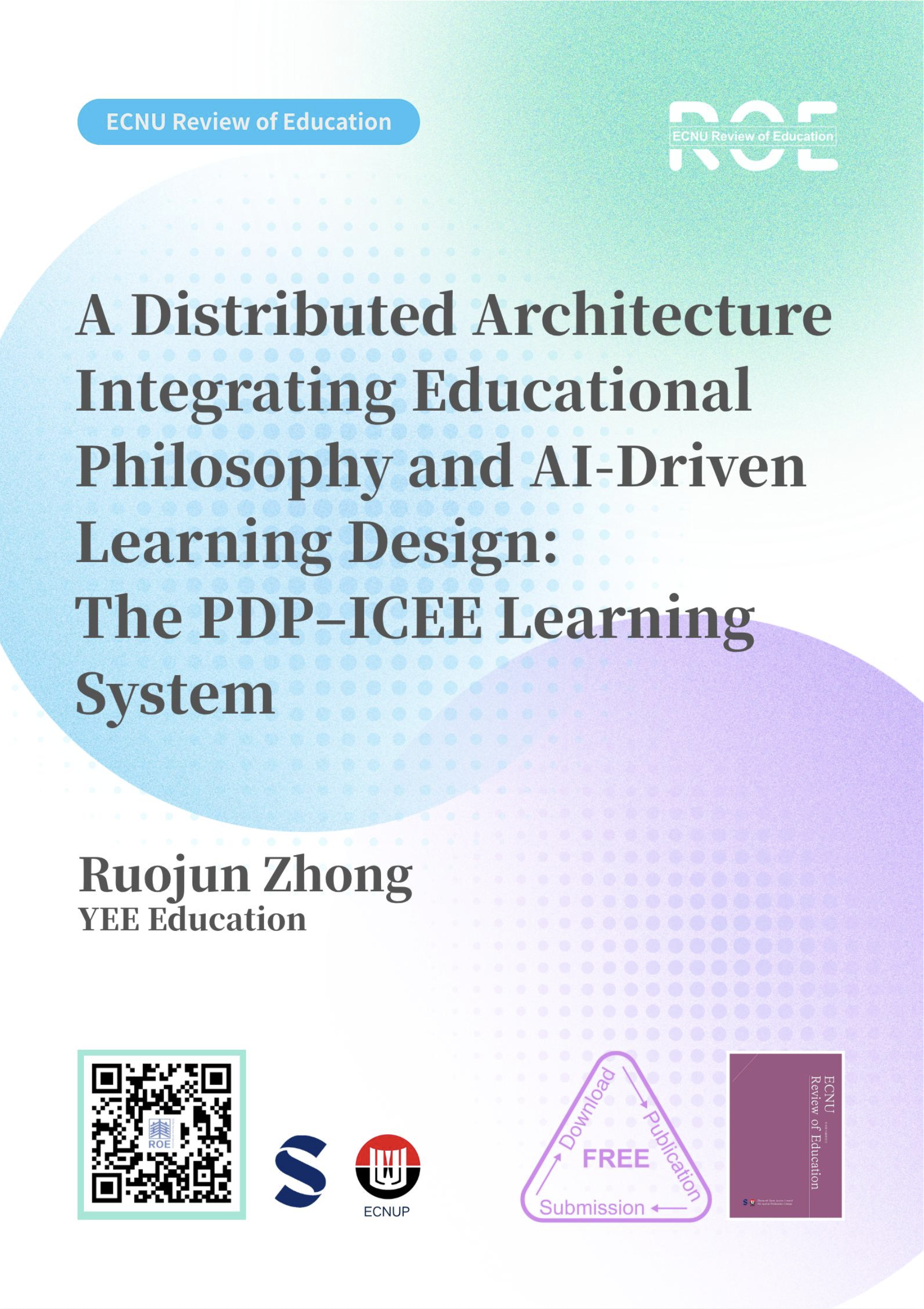
A Distributed Architecture Integrating Educational Philosophy and AI-Driven Learning Design: The PDP–ICEE Learning System

Ruojun Zhong

Education in the age of AI faces an epistemic paradox: It can increasingly observe learning through data and analytics, yet it still struggles to understand learning as a process of meaning. While modern systems exhibit a degree of technical reflexivity, their feedback remains largely procedural and detached from interpretation. Education in the age of AI faces an epistemic paradox: It can increasingly observe learning through data and analytics, yet it still struggles to understand learning as a process of meaning. While modern systems exhibit a degree of technical reflexivity, their feedback remains largely procedural and detached from interpretation.

Read Paper 阅读论文